
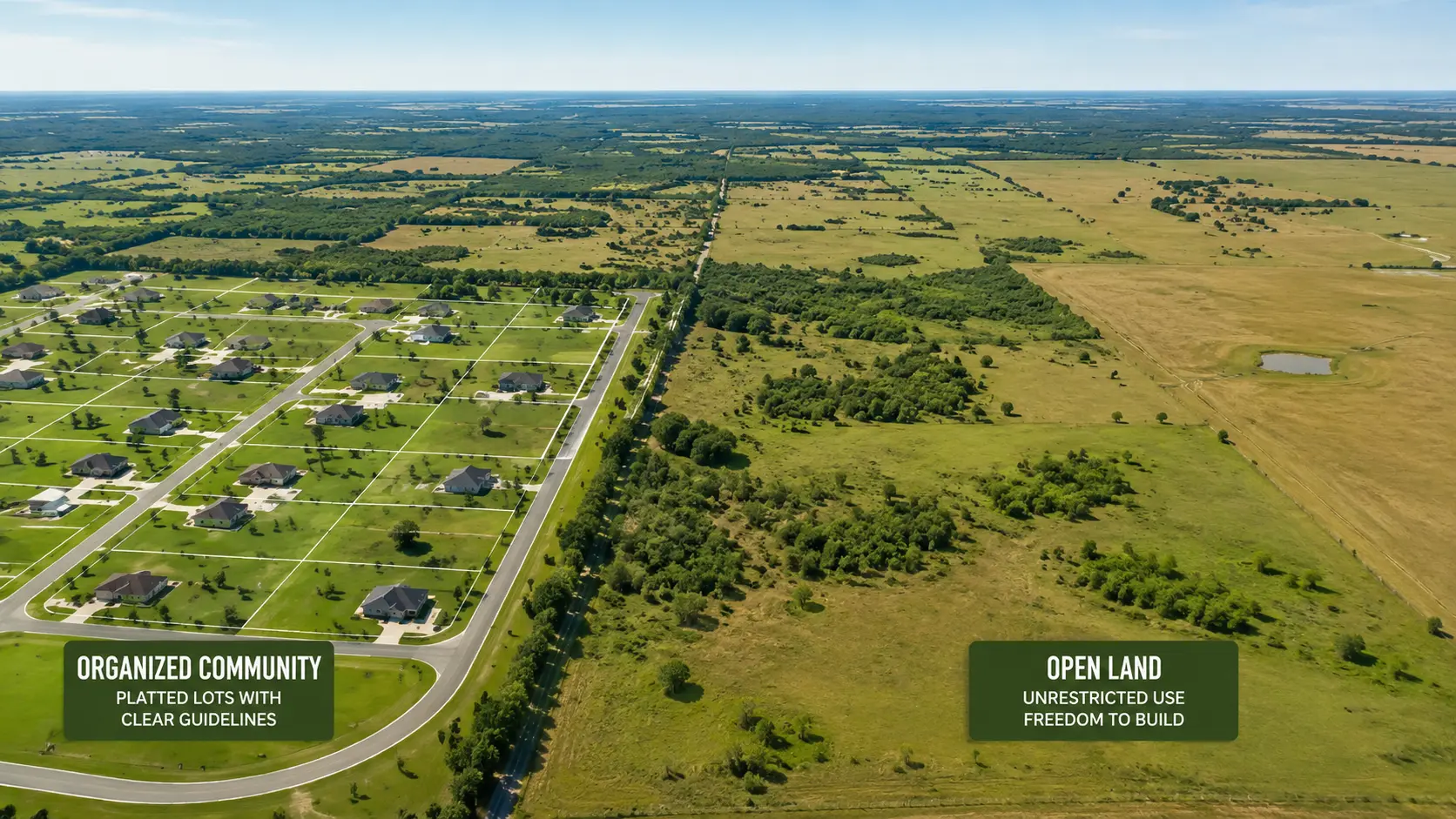
One of the most common questions we get from first-time land buyers is about restrictions. They see listings that say "unrestricted" and assume that is always the better choice. Sometimes it is. Other times, a property with reasonable deed restrictions will protect your investment far better. The right answer depends entirely on what you plan to do with the land and how long you plan to hold it.
What Land Restrictions Actually Are
Restrictions come in several forms. County zoning sets the baseline rules for any land, regardless of who owns it. Deed restrictions are agreed-upon rules recorded in the title that follow the property from owner to owner. HOA covenants are a specific type of deed restriction tied to a subdivision. Conservation easements limit certain uses to protect environmental value.
Not all restrictions are equal. Some are broad and limiting. Others are narrow and easy to live with. The phrase "restricted" in a listing description does not tell you which kind you are dealing with. You have to read the actual documents.
Why Unrestricted Land Appeals to Buyers
The appeal is real. Unrestricted land gives you maximum flexibility. You can run a small business from the property, keep livestock, park equipment, build with alternative materials, or develop the land in ways that a planned community would never approve.
You also avoid HOA fees, architectural review costs, and any governance structure that can get complicated over time.
Unrestricted parcels, especially in rural counties in Arizona, New Mexico, and rural Florida, tend to cost less per acre than similar land in planned communities. For buyers who know exactly what they want to do and want to get started without approval processes, unrestricted land is often the better fit.
When Restrictions Actually Work in Your Favor
Restricted land is not just about limits. In well-planned areas, restrictions protect the value of every property in a neighborhood. They prevent a neighbor from operating a salvage yard next door or installing something that drives your property value down.
Lenders also view restricted properties more favorably. If you ever want to finance the purchase or borrow against the land, deed restrictions tied to a planned community can make the process smoother.
For buyers looking at land as a long-term investment, consistent restrictions can produce more stable appreciation over time.
The Neighbor Problem Nobody Talks About
The biggest argument for restricted land is not what you can do with your property. It is what your neighbor can do with theirs.
In unrestricted areas, there is nothing stopping someone adjacent to your parcel from using their land in ways that hurt your value or your enjoyment. You could invest in a beautiful off-grid homesite, and the parcel next door becomes a storage yard. In restricted communities, that scenario is significantly limited.
Research consistently shows that incompatible adjacent uses can reduce residential property values. How much depends on the market and the severity, but it is a real factor. In unrestricted areas, it is a risk you carry regardless of how carefully you use your own land.
How to Think Through the Decision
Ask yourself a few questions before you decide.
Do you need the flexibility to run a business, keep livestock, or build without approval processes? Unrestricted land is likely the right fit.
Are you buying for long-term appreciation and want the most predictable environment for your investment? Reasonable restrictions can help.
Do you know what the neighboring land looks like and how it is used? In unrestricted areas, that context matters a lot.
We sell both types of land across our markets and we see buyers succeed with both. The key is understanding what you are buying before you close, not discovering it afterward. We note restrictions clearly on every property we list.
Browse our current listings across Arizona, New Mexico, Colorado, Nevada, and Florida.